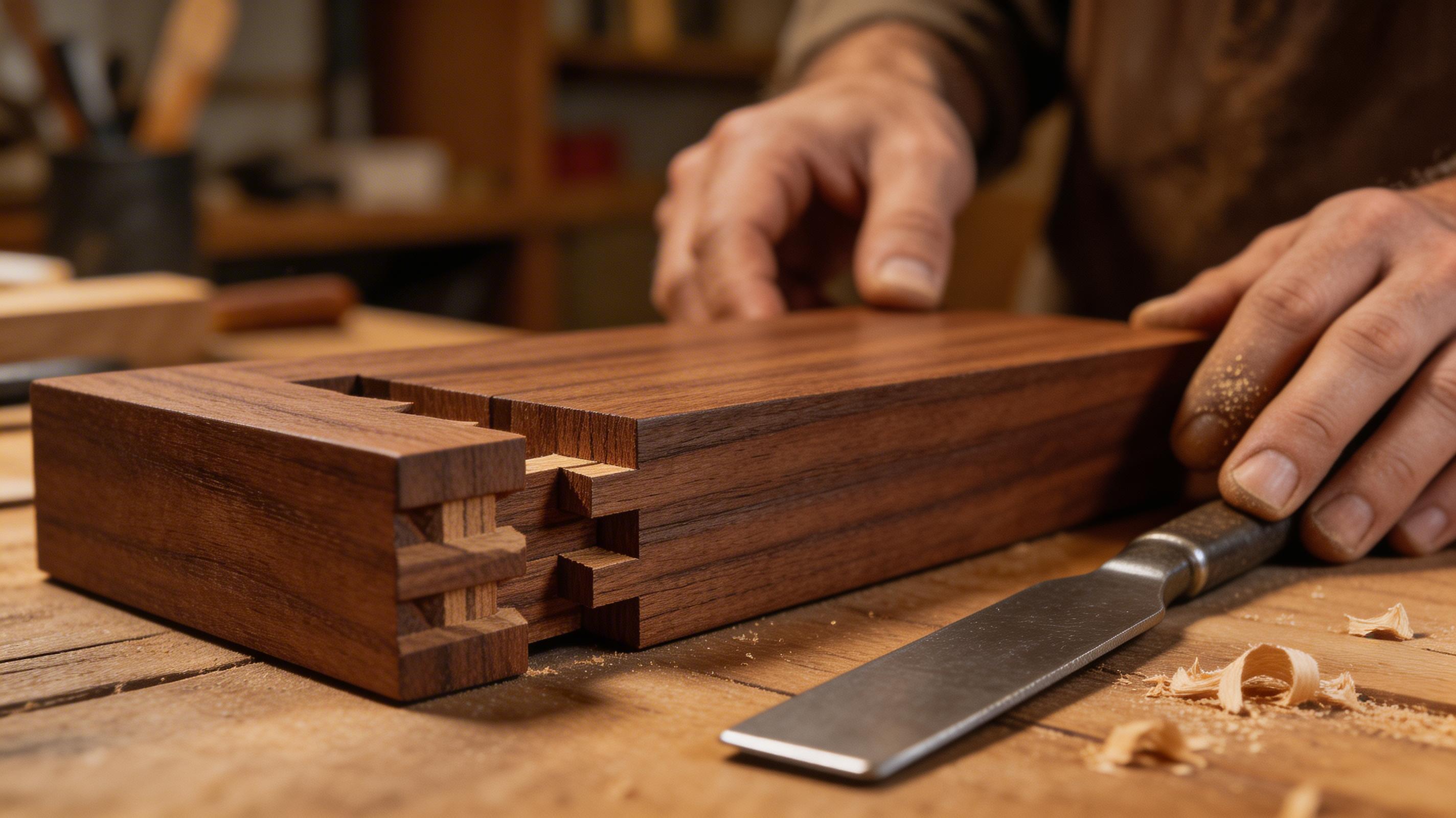
Why Joints Matter More Than You Think
The joint is where woodworking gets serious. A screwed butt joint is quick and strong enough for many purposes. A well-cut dovetail joint is practically indestructible, beautiful, and a signal to anyone who looks at the piece that it was made by someone who knows what they're doing. Understanding which joint to choose — and why — is what separates competent woodworkers from great ones.
The Five Joints Every Woodworker Should Know
1. Butt Joint — The Starting Point
Two pieces of timber meeting face-to-face or end-to-face, held together with screws, nails or glue. The weakest joint in woodworking — end grain glue joints have very low strength. But perfectly adequate for carcass work that's reinforced with screws, especially when using pocket screws (Kreg system). Fast, simple, and used everywhere.
Use for: Cabinet carcasses, shelving, structural frames, anywhere speed matters more than appearance.
2. Rebate (Rabbet) Joint — Easy Upgrade
A notch cut along the edge of one board to accept another. Stronger than a butt joint because there's more long-grain gluing surface. The back panels of cabinets sit in rebates. Easy to cut with a router or table saw.
Use for: Cabinet backs, drawer bottoms, boxes, frames.
3. Dado (Housing) Joint — For Shelving
A channel cut across the grain of one board to accept the end of another. Used for fixed shelves in bookcases and cabinets. The shelf end sits in the channel, preventing it from moving sideways. Very strong when the fit is tight.
Use for: Bookshelves, cabinet fixed shelves, stair treads into stringers.
Ready to put this into practice?
Browse 16,000 step-by-step woodworking plans — every project comes with a full cut list, materials list and diagrams. No guesswork.
Browse Project Plans → Affiliate link — small commission if you purchase, no extra cost to you4. Mortise and Tenon — The Classic Furniture Joint
A rectangular projection (tenon) cut on one piece fits into a matching rectangular hole (mortise) in another. The foundation of frame-and-panel furniture for thousands of years. Enormously strong in racking resistance — it's why chairs and tables built with mortise and tenon joints last for generations. Can be wedged, drawbored, or glued.
Use for: Chair and table legs into rails, door frames, workbench construction.
💡 The tenon should be one-third the thickness of the stock. So for 25mm stock, make a tenon 8mm thick. Aim for a fit that requires hand pressure but doesn't need a mallet.
5. Dovetail Joint — The Masterclass
Interlocking wedge-shaped tails and pins that resist being pulled apart. The mechanical strength is extraordinary — a well-cut dovetail joint in hardwood will fail in the wood before it fails in the joint. Used for drawer corners and box construction for centuries. Takes practice to cut well by hand, but the result is unmistakably the mark of a skilled craftsperson.
Use for: Drawer construction, boxes, jewellery boxes, blanket chests.
Modern Joinery — Pocket Screws and Biscuits
Pocket screw systems use a jig to drill angled holes, allowing boards to be joined quickly and strongly without complex hand joinery. Enormously popular for kitchen and bathroom cabinetry. Not the most beautiful joint, but hidden inside a carcass it doesn't need to be. Biscuit joints use oval compressed beech wafers in matching slots — good for alignment but not particularly strong. Pocket screws have largely superseded biscuits for most applications.
| Joint | Difficulty | Strength | Tools Needed | Best Application |
|---|---|---|---|---|
| Butt | Beginner | Low | Drill, saw | Structural frames, carcasses |
| Pocket Screw | Beginner | Medium | Pocket jig, drill | Cabinetry, face frames |
| Rebate | Beginner | Medium | Router or table saw | Cabinet backs, boxes |
| Dado/Housing | Intermediate | Good | Router or table saw | Fixed shelving |
| Mortise & Tenon | Intermediate | Excellent | Chisels, saw, drill | Chairs, tables, frames |
| Dovetail | Advanced | Outstanding | Chisels, saw, marking tools | Drawers, boxes |
Need something to build?
16,000 step-by-step woodworking plans — furniture, garden builds, sheds, storage and more. Every plan includes a cut list, materials list and full diagrams.
Browse All Project Plans → Affiliate link — we may earn a small commission if you purchase, at no extra cost to you