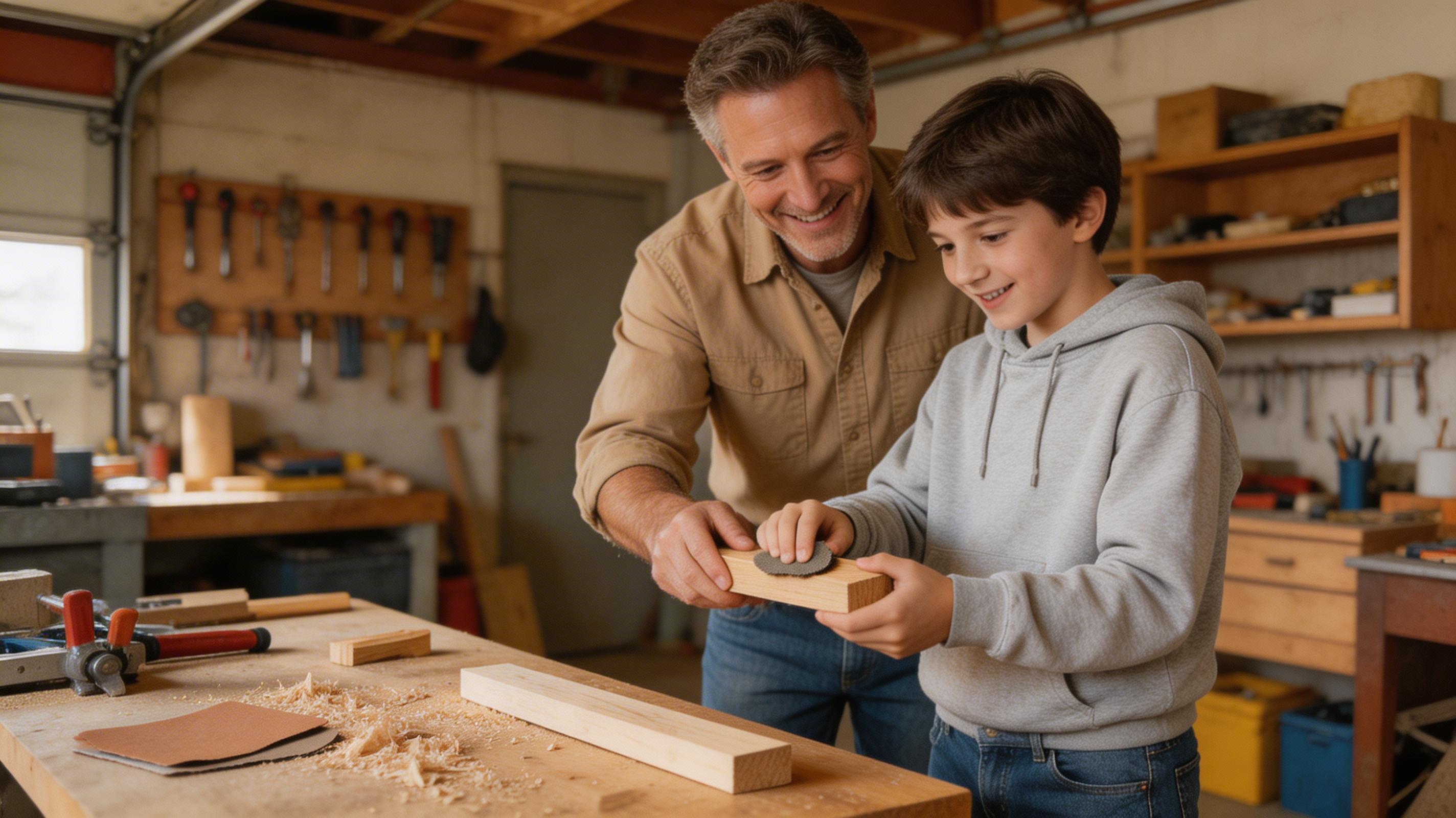
The Problem No Parent Wants to Admit
Your kid is on their phone or tablet for hours every day. You know it's too much. They know it's too much. But the alternative — telling them to "go outside" or "find something to do" — produces an eye-roll and thirty seconds of looking around before the screen comes back out.
The problem isn't willpower. It's that screens offer something genuinely compelling: stimulation, connection, achievement. To pull a child away from that, you need to offer something better — not just different. Something that also produces stimulation, connection and achievement. Something that leaves them with a physical result they made with their own hands.
Building something together in a workshop does exactly that.
Why Woodworking Works
It's not about the wood. It's about what happens in a workshop that can't happen on a screen:
- Immediate, tangible results — within an hour a child can hold something they made. This is viscerally satisfying in a way no game achievement can match.
- You actually need each other — holding a board while it's cut, passing a tool, measuring together. Collaboration is built into the process.
- Failure is fine — a cut that goes slightly wrong gets fixed or becomes part of the character of the piece. There's no game over screen.
- No notifications — phones don't belong in workshops. This rule enforces itself.
- They're learning something real — mathematics (measuring), physics (how tools work), material science (why timber behaves as it does). Skills they'll use for life.
Ready to put this into practice?
Browse 16,000 step-by-step woodworking plans — every project comes with a full cut list, materials list and diagrams. No guesswork.
Browse Project Plans → Affiliate link — small commission if you purchase, no extra cost to youThe Conversation Before You Start
Don't frame it as "instead of your phone." Frame it as an invitation: "I'm going to build something this weekend and I could use your help." Give them a genuine role — not watching while you do everything, but actually doing things themselves. Children disengage when they feel like a spectator.
Let them make decisions — what to build, what colour to paint it, which way the boards face. Ownership drives engagement.
Best First Projects by Age
| Age | Project | Skills Learned | Time |
|---|---|---|---|
| 6–8 years | Painted wooden sign, simple box, bird feeder | Sanding, painting, hammering nails, measuring | 1–2 hours |
| 9–11 years | Shelves, step stool, small storage crate, phone stand | Measuring, drilling, driving screws, sanding progressively | 2–4 hours |
| 12–14 years | Garden bench, bookshelf, small table, toolbox | Cutting with a saw, basic joinery, finishing, project planning | One weekend |
| 15+ years | Coffee table, garden chair, cabinet, workbench | Advanced joinery, design, tool selection, independence | Multiple weekends |
Safety Rules That Become Good Habits
Safety in the workshop isn't about keeping children away from tools — it's about teaching them to use tools properly. A child who learns safe tool habits young is less likely to have an accident than an adult who never learned.
- Always cut away from your body — chisels, knives, and saws always cut in the direction away from you.
- Both hands behind the cutting edge — the hand that isn't holding the tool is always behind where the tool is working.
- Clamp the work, not yourself — the piece being worked on is clamped to the bench. You never use your body to hold it steady while cutting.
- Sharp tools are safer than blunt ones — a blunt chisel requires more force and is more likely to slip. Keep edges sharp.
- No running, no rushing — workshops require attention and care. Work at a measured pace.
💡 The moment a child completes their first project and shows it to someone else — a sibling, a grandparent, a friend — and receives genuine appreciation for it, something shifts. They made something real that exists in the world. That feeling is addictive in the best possible way.
What Happens to the Relationship
Parents who regularly build with their children report something consistent: the quality of conversation changes. Something about standing side by side, focused on a shared task, with hands busy — it unlocks the kind of talk that never happens face-to-face across a dinner table.
Two to three hours in the workshop on a weekend isn't just screen time offset. Over a few months, it becomes the thing both of you look forward to.
Need something to build?
16,000 step-by-step woodworking plans — furniture, garden builds, sheds, storage and more. Every plan includes a cut list, materials list and full diagrams.
Browse All Project Plans → Affiliate link — we may earn a small commission if you purchase, at no extra cost to you